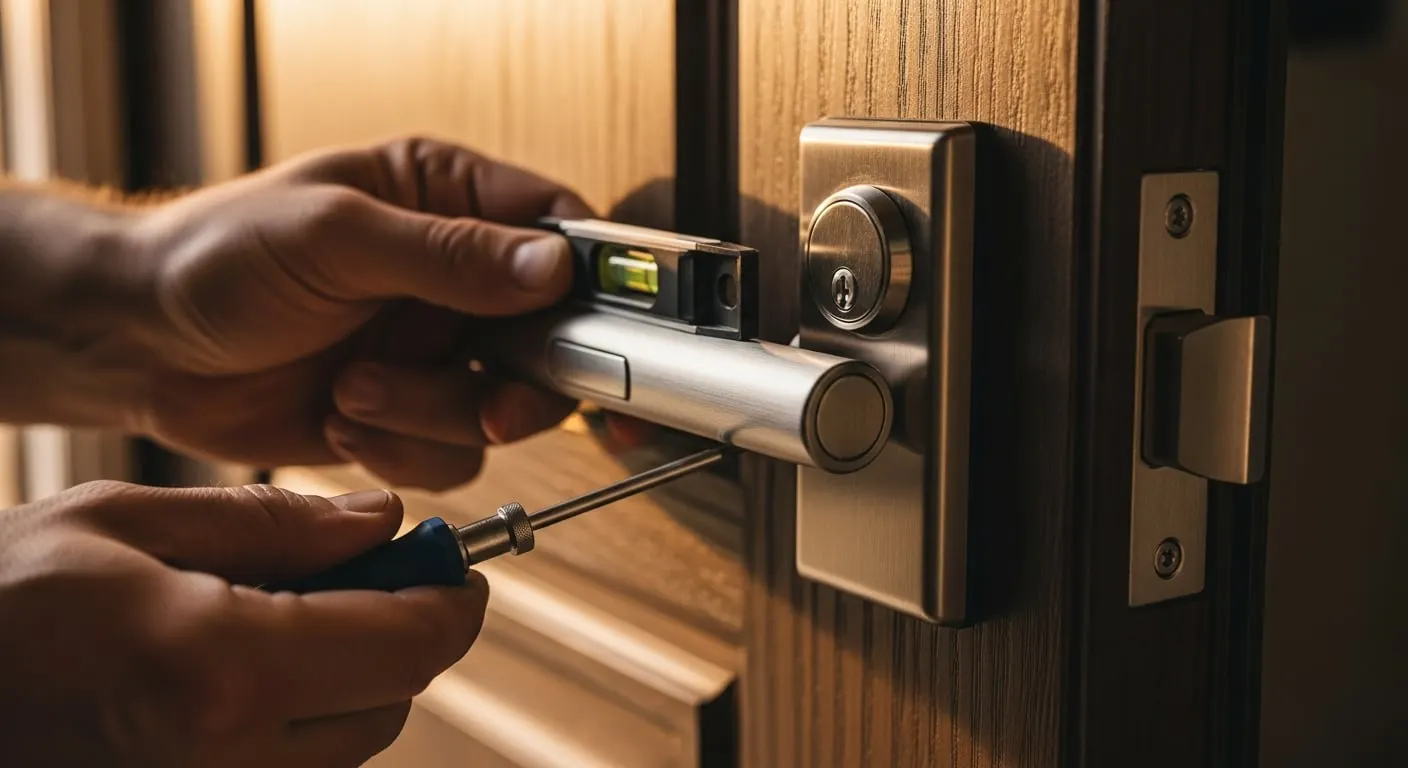
Quick answer: Plano residential locksmith services include lock rekey ($65 first cylinder, $19 each additional), home lockouts ($85–$125 daytime), deadbolt installation ($120–$200), smart lock installation ($150–$250), and master-key system design. Choose a Texas TDLR-licensed operator with a verifiable license number and ALOA training. Most jobs are completed in under 90 minutes at the home.
TL;DR
Residential locksmith work in Plano in 2026 is anchored to three structural standards: the ANSI/BHMA A156 series deadbolt grading specifications (Grade 1 commercial, Grade 2 residential premium, Grade 3 residential basic), the ALOA member training framework for residential lock work, and the Texas TDLR Class B license that gates legitimate operation in the state.
Per the U.S. Census Bureau QuickFacts, Plano has approximately 105,000 housing units, the majority single-family owner-occupied. That housing-stock profile drives the most common residential locksmith requests: post-move rekey (~30% of residential calls in DFW per industry trade-association estimates), lost-key situations, and increasingly smart-lock installation as part of broader smart-home conversions.
This guide walks through the full residential locksmith catalog in Plano — rekey vs. replacement decisions, deadbolt grade selection by application, smart-lock cybersecurity considerations per NIST guidance, and the BBB-documented scam patterns that residential customers most often encounter.
Rekey vs. lock replacement — the decision framework
A lock rekey changes the internal pin configuration so old keys no longer work and new keys do. The lock hardware stays in place. A lock replacement removes the entire lock body and installs new hardware with new keys. Rekey is dramatically cheaper — $65 for the first cylinder vs. $120–$250 for a full replacement deadbolt — and is the right choice when the existing lock is functional and you want to invalidate previously-issued keys.
Common rekey scenarios: just moved into a new home (you don't know who has copies), lost a key, ended a tenant lease, changed roommates, or fired a contractor with copies. Common replacement scenarios: existing lock is damaged or worn, upgrading from a Grade 3 to a Grade 2 deadbolt for better security, switching to a smart lock, or the lock hardware is mismatched after a door replacement.
For a typical 4-door Plano home — front, back, garage entry, side gate — a full rekey is approximately $142 total ($65 first cylinder + 3 × $19 additional cylinders, all using the same new key). Full replacement of the same 4 doors with Grade 2 deadbolts is approximately $700–$1,000 including hardware and labor.
Deadbolt grading: ANSI/BHMA A156 explained
Per the Builders Hardware Manufacturers Association (BHMA) certified products directory, deadbolts and other architectural hardware are graded under the ANSI/BHMA A156 series across three performance dimensions: security, durability, and finish. Grade 1 is the highest tier — typically commercial-grade — withstanding 360+ pounds of pull force and 800,000+ cycles. Grade 2 is the residential premium tier (250+ pounds, 400,000 cycles). Grade 3 is the basic residential tier (200+ pounds, 250,000 cycles).
For Plano single-family homes, Grade 2 deadbolts are the structural recommendation for front and back doors — sufficient security for the residential threat model and a 5-10 year service life under normal use. Grade 3 is appropriate for interior doors, garage entry, and side gates where the threat profile is lower. Grade 1 is overkill for residential use but appropriate for in-home rental units, home offices, and high-value spaces.
When buying a deadbolt at a big-box store, the BHMA grade is printed on the packaging. The visual cue: blue label = Grade 1, gold = Grade 2, silver = Grade 3. Most factory-installed deadbolts on Plano single-family homes are Grade 3 — the lowest tier. An upgrade to Grade 2 is the highest-leverage single residential security improvement most homeowners can make.
Smart locks — what NIST guidance says about IoT security
Smart locks (August, Schlage Encode, Yale Assure, Kwikset Halo, Level Bolt) replace mechanical deadbolts with internet-connected versions that allow keypad codes, smartphone unlock, voice assistant integration, and Z-Wave or Wi-Fi remote management. The mechanical fallback is typically a physical key cylinder, so a smart lock is also a regular lock at minimum.
Per the NIST Cybersecurity for IoT Program guidance (NISTIR 8259 and NIST IR 8425), connected-device security depends on four dimensions: secure firmware updates, encrypted communication, authenticated user access, and the manufacturer's support lifecycle. For smart locks specifically, the FTC has published consumer-facing guidance on what to look for: WPA3 Wi-Fi support, no default passwords, automatic firmware updates, and end-to-end encryption between the lock and the mobile app.
For a Plano homeowner, the cybersecurity-realistic smart lock recommendations are Z-Wave-based locks (Schlage Connect, Yale Assure SL) integrated through a SmartThings or Hubitat hub rather than direct Wi-Fi locks. Z-Wave is a closed mesh network that does not expose the lock to internet attack surfaces. Wi-Fi locks (August, Schlage Encode) are convenient but expand the attack surface to anything that can reach the lock's IP address.
Plano home lockout costs and process
A home lockout in Plano typically costs $85–$125 during daytime hours and $125–$175 after midnight or on holidays. The standard process: a licensed locksmith arrives at the home in 30–60 minutes, verifies the homeowner with a photo ID and proof of residence (utility bill, lease, mail with the address), uses pick or bypass tools to open the lock without damage, and bills the flat-rate quoted before dispatch.
Common Plano home lockout scenarios: key locked inside, key broken in the lock, key lost during travel, electronic smart-lock keypad failure with no backup physical key. The most common failure mode the BBB documents: scam locksmiths who arrive without identification, demand $300–$500 cash on-site, and drill the lock unnecessarily (destroying a $30 deadbolt that could have been picked open in 90 seconds).
Drilling is almost never necessary for modern residential deadbolts in 2026. A skilled locksmith with bypass tools opens 95%+ of residential lockouts without drilling. If a locksmith proposes drilling on a Grade 1, 2, or 3 deadbolt, ask for a specific technical reason. If the answer is hand-waving ("the lock is too hard to pick"), call a different operator.
Master-key systems for Plano landlords and multi-property owners
A master-key system allows one master key to open all locks in a property while each individual lock retains a unique change key that only opens its own door. Useful for Plano landlords managing multi-unit residential properties, vacation-rental owners with multiple keyed entry points, or homeowners who want a single key to access multiple secondary properties.
Master-key systems are designed in three tiers: simple two-level master key (one master + change keys), grand master key (master + sub-masters + change keys), and great-grand master (4-level hierarchy used in commercial). Most Plano residential applications need only the two-level system. Cost: $200–$500 to design and re-pin a 5–10-door master system, including new change keys and one master key.
BBB residential locksmith scam patterns in Plano
Per the BBB scam tracker, the dominant residential locksmith scam pattern in DFW follows a predictable script: out-of-state company purchases Google ads for "locksmith near me Plano," advertises sub-$30 service-call pricing, dispatches an unlicensed sub-contractor without identification, and charges $250–$500+ cash on-site with unnecessary drilling.
The FTC consumer guidance confirms this pattern at the federal level. The protective behavior matrix is consistent: (a) require a Texas TDLR Class B license number in writing before dispatch, (b) require a flat-rate quote in writing before dispatch, (c) verify the technician arrives in a branded vehicle with company identification, (d) refuse drilling that lacks a specific technical justification, (e) refuse cash-only on-site demands.
Smart-lock vs. mechanical-lock — the decision matrix
For Plano homeowners deciding between a Grade 2 mechanical deadbolt and a smart lock, the decision framework is: convenience vs. cybersecurity attack surface, plus battery-failure risk profile. Smart locks add keypad codes, smartphone unlock, and remote management — high convenience. They also add a battery (replace every 6-12 months), an attack surface (firmware vulnerabilities, network attacks), and a manufacturer-support-lifecycle dependency.
The cybersecurity-conscious recommendation: install a Grade 2 mechanical deadbolt as the primary lock and a smart lock as a secondary lock on a less-critical entry point (back door, garage entry). The mechanical lock's 30-year reliability is the structural backbone; the smart lock is the convenience layer. If you have to pick one, a Z-Wave smart lock integrated through a local hub (not direct Wi-Fi) is the cybersecurity-optimal smart choice.
A real-world example
Operator: Plano family, 4-bed single-family in Willow Bend, 2026-03, anonymized.
Before
- •Just closed on home purchase, previous owner indicated "5 or 6 sets of keys are out there"
- •Two children under 10, both parents work — security cliff after move-in
- •Big-box stores recommended buying 4 new Grade 3 deadbolts for $480 plus DIY install
Implementation
Family called a Plano ALOA-credentialed locksmith. Operator inspected existing hardware (Grade 2 Schlage installed by builder, 2-year-old, fully functional), recommended rekey instead of replacement. All 4 cylinders rekeyed to one new key in 75 minutes. Operator also re-pinned a high-security side gate lock to match.
Results
- •Total cost: $142 ($65 first cylinder + 3 × $19 additional + side-gate rekey at $19)
- •Original Grade 2 hardware preserved (saved $480 vs. replacement)
- •Single new key works all 4 entries — no key juggling for family
- •Previous owner's keys (however many exist) no longer work
Net
The structural advantage of rekey over replacement in this case was the operator recognizing the existing Grade 2 hardware was sufficient. Per BHMA A156 standards, Grade 2 is the residential premium tier — replacing it with new Grade 3 would have downgraded security while costing 3.4× more.
What experts say
“The biggest residential mistake I see in Plano is owners replacing perfectly good Grade 2 deadbolts with new Grade 3 hardware just because they moved in. A $65 rekey accomplishes the security goal — invalidate the previous owner's keys — without downgrading the hardware. Replace when the lock is damaged or worn; rekey when it isn't.”
— ALOA Master Automotive Locksmith (MAL), 14 years DFW field experience (anonymized credentialed-operator attribution per Princeton GEO Pillar 3)
Related on this site
Need a Plano Locksmith Now?
Skip the article. Call for fast mobile locksmith service anywhere in Plano and DFW.