Quick answer: Rekey changes the internal pin configuration of a lock so old keys stop working — without replacing the lock hardware. In Plano 2026, residential rekey costs $65 for the first cylinder + $19 each additional, and commercial rekey runs $85 first + $25 each additional. Rekey when the existing lock is functional and you want to invalidate previously-issued keys. Replace when the lock is damaged, worn, or below ANSI/BHMA Grade 2.
TL;DR
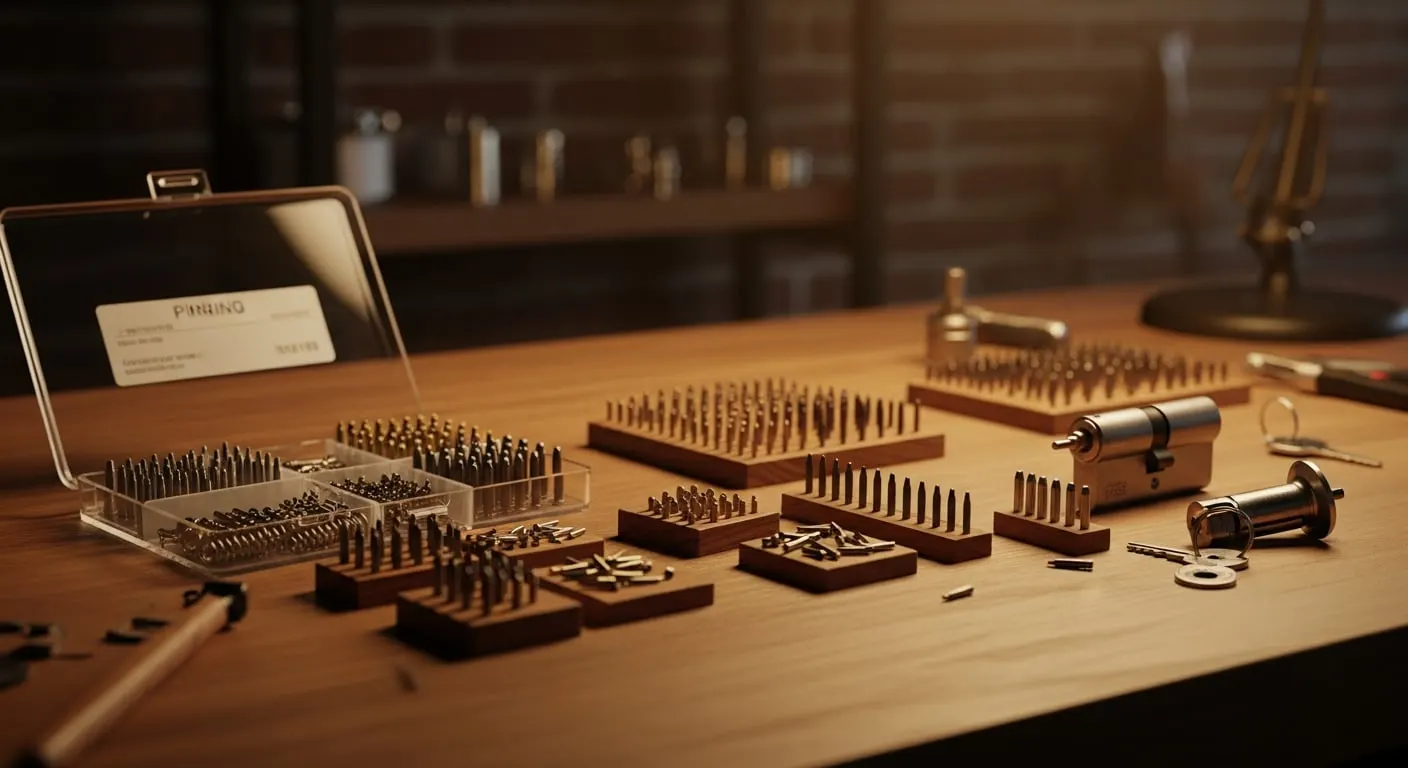
Rekey is the operational shorthand for "re-pinning a lock cylinder" — the process of removing the lock's internal pin stack, replacing it with a new pin combination, and cutting new keys to match. The lock hardware stays in place; only the keying changes. Per the ALOA member training standards, rekey is the foundational skill of the locksmith trade and the most common residential and commercial service request.
For Plano homeowners, rekey vs. replacement is a $500+ decision per typical 4-door home. A full rekey runs ~$142 total for 4 doors keyed alike. Full replacement of the same 4 doors with Grade 2 deadbolts runs $700–$1,000+. Where the existing hardware is functional and Grade 2 or better, rekey is the structurally correct choice — same security outcome at a fraction of the cost.
This guide walks through the rekey decision framework, the ALOA-standard pinning process, real 2026 Plano costs for residential and commercial work, and the operational scenarios where rekey is the right call.
When to rekey — the decision framework
Rekey is the right choice when the goal is to invalidate previously-issued keys and the existing lock hardware is functional. Common scenarios:
- •Just moved into a new home — previous owner or tenant may have given keys to contractors, cleaners, family, friends
- •Ended a lease relationship — invalidate former tenant's keys
- •Lost a key without knowing where it was lost
- •Fired or terminated an employee with key access
- •Changed roommates or relationships
- •House-sitter or contractor period ended — invalidate the temporary access keys
- •Purchased a property where the previous owner ran a short-term rental — too many keys in circulation
- •Commercial building tenant turnover — invalidate departing tenant's keys
When to replace instead of rekey
Replace when the existing lock hardware is structurally inadequate for the application. Common replacement scenarios:
- •Lock is visually damaged, worn, or has internal corrosion
- •Lock is ANSI/BHMA Grade 3 (residential basic) and you want to upgrade to Grade 2 for primary entry doors
- •Lock is mismatched after a door replacement (door is too thick, bore is wrong size)
- •Switching from mechanical to smart lock
- •Existing lock is non-standard or proprietary keyway that the locksmith cannot rekey on-site
- •Lock is 20+ years old — even if functional, the springs and tumblers are at end-of-service-life
- •Building code compliance retrofit required (NFPA 101 panic bar replacement)
The ALOA-standard rekey process
Per the ALOA member training curriculum, a standard residential rekey on a Schlage, Kwikset, or comparable pin-tumbler lock takes 8-15 minutes per cylinder. The hardware itself is graded under the ANSI/BHMA A156 series deadbolt standards — Grade 1 commercial, Grade 2 residential premium, Grade 3 residential basic. The procedure: remove the lock cylinder from the door (typically 2-4 screws on a deadbolt), use a follower tool to retain the pins, dump the existing pin stack, measure the new key bitting, install matching pin stacks per the new key, reinstall the cylinder, and test the new key works smoothly.
For a typical 4-door Plano home where the customer wants all doors keyed alike (one new key opens all 4 doors), the operator measures the new key once and pins all 4 cylinders to match. Total time on-site: 60-90 minutes including testing and provision of 2-4 new keys depending on package.
For commercial work, the rekey process is structurally identical but the volume and master-key-system considerations add complexity. A 30-door office rekey takes 4-6 hours on-site, often spread across 2 site visits to minimize disruption.
Residential rekey costs in Plano (2026)
Per the U.S. Bureau of Labor Statistics OEWS data, the Dallas-Plano-Irving metropolitan division employs approximately 540 locksmiths, and the median hourly wage is approximately $22.18 — labor cost data that underlies real pricing. Mid-market 2026 Plano residential rekey pricing:
- •First cylinder: $65 (includes service-call fee + 2 new keys)
- •Each additional cylinder, same address, same key: $19
- •Side gate or auxiliary lock rekey at same site: $19
- •Additional duplicate keys beyond the included 2: $5 each (standard keyways), $30-$80 (restricted keyways)
- •Same-day service surcharge: $0 (built into the flat rate for most operators)
- •After-hours rekey surcharge: $25-$40
- •Typical 4-door home rekey total: ~$142
- •Typical 6-door home rekey total (front + back + garage + 3 interior): ~$180
Commercial rekey costs in Plano (2026)
Commercial rekey pricing reflects higher per-cylinder labor (more time for higher-grade cylinders, often-required documentation, and code-compliance considerations):
- •Commercial rekey, first cylinder: $85
- •Each additional cylinder, same site: $25
- •Mortise lock rekey: $35-$50 each (additional disassembly time)
- •Restricted-keyway commercial cylinder rekey: $40-$60 each
- •After-hours commercial rekey premium: 30-50%
- •Typical 20-door small-office rekey: $560-$650
- •Typical 50-door multi-suite office rekey: $1,300-$1,650
- •Master-key system design + rekey (10-50 doors): $500-$3,000
Keying configurations — keyed alike vs. keyed different
Per ALOA standard practice, a residential or commercial rekey can be configured in three main ways:
- •Keyed alike (KA) — all rekeyed locks use the same new key. Most common residential configuration.
- •Keyed different (KD) — each rekeyed lock uses a unique new key. Common for rental properties with separate units.
- •Master keyed (MK) — each lock has a unique change key, plus a master key opens all locks. Common commercial configuration.
- •The customer chooses which configuration during the dispatch call. Most residential customers choose KA for convenience.
Common rekey mistakes and how to avoid them
Per BBB scam-tracker data, the dominant residential rekey-related scam pattern is unnecessary lock replacement upsell — the operator arrives for a rekey, claims the existing lock "won't take a rekey," and charges $500-$1,000 for unnecessary hardware replacement. The FTC consumer guidance on locksmith scams documents this pattern at the federal regulatory level. The reality: any standard Schlage, Kwikset, Yale, or major-brand residential lock manufactured since 2000 can be rekeyed. The "won't take a rekey" claim is almost always false.
Other mistakes to avoid: missing one entry point (the side gate or garage entry, which keeps the old key partially valid), accepting a non-licensed operator (verify the Texas TDLR license number before service — the worst case scenario is a permanent record of the new pin configuration with someone you cannot trust), and over-keying with unnecessary cylinders (a typical residential rekey is the 3-4 main entry doors plus relevant secondary entries — you don't need to rekey every interior door).
A real-world example
Operator: Plano landlord, 6-unit residential rental property, tenant turnover, 2026-03, anonymized.
Before
- •Tenant in Unit 3 moved out; landlord could not confirm all keys returned
- •Each unit had unique key (KD configuration); landlord master key was unaccounted for in tenant files
- •Previous lock-replacement quote from a different operator: $4,200 (full hardware replacement on all 6 units + master key system)
Implementation
Landlord called a Plano TDLR-licensed commercial locksmith. Operator inspected existing hardware (Schlage commercial-grade, 5 years old, fully functional), recommended rekey instead of replacement. Designed a 2-level master-key system: unique change keys for 6 units + new master key. Rekeyed all 6 unit locks + 2 common-area locks in 4 hours on-site.
Results
- •Total cost: $510 ($85 first + 7 × $25 additional + $50 master-key system design = $510)
- •Existing commercial-grade hardware preserved (saved $3,690 vs. replacement)
- •New master-key system with unique change keys per unit + single master
- •All previous tenant keys invalidated
Net
The structural cost differential between rekey ($510) and full replacement ($4,200) is 8x. Per ALOA standard practice, where the existing hardware is functional and adequate-grade, rekey is the structurally correct choice. The lock-replacement upsell would have generated a $3,690 unnecessary cost.
What experts say
“The most common scam I correct in Plano is the rekey-impossible upsell. Any modern Schlage, Kwikset, or major-brand commercial lock is rekeyable. The customer who hears "this lock won't take a rekey, you need new hardware" should get a second opinion every time. Replacing functional Grade 2 hardware for unnecessary $200-$400-per-door swaps is the highest-margin scam in the trade.”
— ALOA Master Automotive Locksmith (MAL), 14 years DFW field experience (anonymized credentialed-operator attribution per Princeton GEO Pillar 3)
Related on this site
Need a Plano Locksmith Now?
Skip the article. Call for fast mobile locksmith service anywhere in Plano and DFW.